


South Sudan's Food Security Efforts Through Organic Agriculture. Thank you

Shalom to you, brothers and sisters in Yeshua the Messiah. It has been one month since my return to the USA on June 23rd, after spending eight months in South Sudan. Our mission with Operation Nehemiah has been to implement various activities that bring sustainability to those returning from exile, helping them reclaim their country after years of war, displacement, and captivity. With your support, we are making a significant impact, by the grace of God, in the lives of countless families who are standing on their feet and rebuilding their lives, both spiritually and physically.
South Sudan's political situation
Upon returning to the USA, many benefactors have inquired about living conditions in South Sudan, the government, the economy, and the situation for Christians there. The political situation in South Sudan remains fragile yet relatively stable in Eastern Equatoria state, where ONMI has operated since 2004. Issues such as road ambushes, rebel activities, cattle raiding, and constant displacement have ceased. South Sudan celebrated its 15th year of independence on July 9, 2026. The country has not held free elections since 2011 due to national instability, but it is preparing for general elections in December 2026. We need your prayers for a successful election and transition of power. The church is thriving despite these challenges. Christians are called to persevere even during a crisis, not to shrink back.
Future perspectives of South Sudan.
The country is unlikely to revert to all-out war as seen in previous years. However, tens of thousands of citizens remain in refugee camps, uncertain whether to return home or stay in camps where the UNHCR has depleted food rations. Despite this, thousands are voluntarily returning home to rebuild their lives. These individuals are receiving essential services such as water, food, education, and medical care from ONMI, with your support, to help them stand on their feet.
Economic situation of South Sudan: the impact of your long-term support to ONMI
South Sudan's economy is navigating significant challenges. Despite the grim outlook, we at ONMI, with your support, are making a meaningful impact. As of May 2025 - 2026, the headline inflation rate in South Sudan is 58.21%, according to the National Bureau of Statistics (NBS), compared to the latest U.S. Bureau of Labor Statistics (BLS) data, the annual inflation rate for the 12 months ending June 2026 is 3.5%, which is 54.71 % higher than in the USA. Since gaining independence in 2011, the exchange rate of the US dollar ($) to the South Sudanese pound (SSP) was $1 = 1SSP; 14 years later, in 2026, the currency exchange rate has dramatically shifted to $1 USD equaling 7,500 SSP. The country is facing a severe economic crisis, underscoring the crucial role of your support for ONMI's long-term vision and goals. Additionally, South Sudan relies heavily on East Africa for its food supply, importing 95% of its food. The cost of gas in South Sudan has soared, with one gallon of petrol or diesel priced at $8, double the cost of the same commodity in the USA, even amidst the ongoing conflict in the Middle East.
Today, I will focus on food security, a crucial aspect of the ONMI programs you have been supporting.

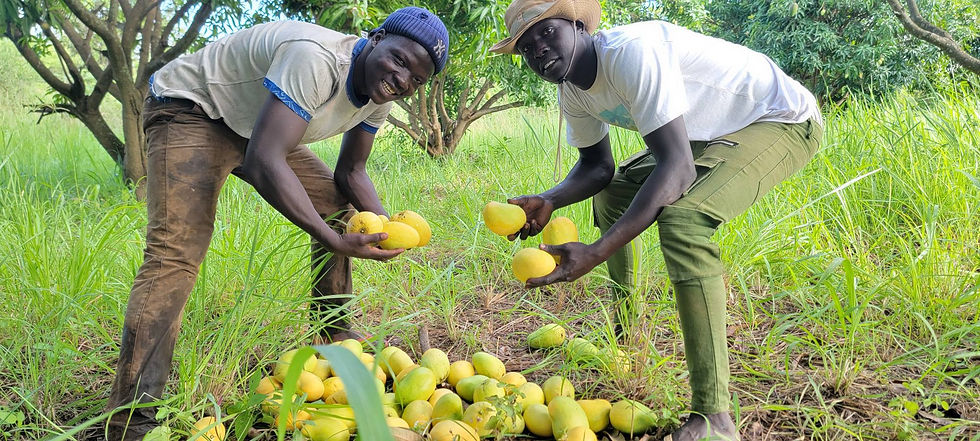
Mango from plantation to harvest: 2 years
Food security remains a pressing issue and central to the work of ONMI in South Sudan, where many communities face hunger and malnutrition. From October 27, 2025, to June 23, 2026, I spent eight months in South Sudan managing Operation Nehemiah Mission’s vision to improve food security by promoting organic agriculture and agroforestry. Working alongside my family and mission staff, we focused on increasing food production on 20 acres of land by planting a variety of tropical crops suited to the region’s climate. As we enter the first harvest season of 2026, it is clear that while progress has been made, significant challenges threaten the success of our efforts.

Cassava - duration from plantation to harvest- 1 yearr

Cassava - duration from plantation to harvest- 1 yea

Cassava - duration from plantation to harvest- 1 year

Banana from Plantation to harvest - 2 years

Cassava stalk- duration from plantation to harvest- 1 year.

Sorgham from plantation harvest: 4 months


Sun Flower from pLantaton to harvest - 4 months.


Preparing the Land and Planting Crops for the second season July - December, 2026
The Second Season for 2026 began last month in July, and we are now in August. The planting season spans August through September to ensure a harvest in December and January. We have 20 acres to plow and plant within these two months. To achieve this goal, we require $15,000 this month. This funding will cover the costs of tractor maintenance, fuel, seeds, insecticide, labor, and maintenance.
During the next two months of 2026, we will clear and prepare 20 acres of land for planting. This involved:
Removing trees and debris
Testing soil quality to determine nutrient needs
Planting a mix of annual and perennial crops to maximize yield throughout the year
Scheduling planting according to weather patterns to optimize growth
The Vision Behind Operation Nehemiah Mission
Operation Nehemiah Mission aims to address food insecurity by encouraging sustainable farming practices that rely on organic agriculture and agroforestry. Our goal is to cultivate crops that can be harvested annually and perennially, providing a steady food supply for local communities. The crops we planted include beans, peanuts, sunflowers, sweet potatoes, sorghum, rice, cassava, banana, soybean, maize, mangoes, and oranges. These crops were selected for their adaptability to tropical climates and their nutritional value.
The mission also emphasizes working closely with local families and staff to build knowledge and skills in organic farming techniques. This approach supports long-term food security by reducing dependence on chemical fertilizers and pesticides, which are often expensive and unavailable.
The planting season was carefully timed to match the rainy season, which is critical for crop development in South Sudan’s climate. For example, sorghum and maize were planted early to take advantage of the rains, while fruit trees like mangoes and oranges were planted to establish roots for future harvests.
Challenges Impacting Crop Success
Despite careful planning, several obstacles have limited the success of our crops so far:
Our resources for managing pests and diseases are scarce, and we lack of proper weeding tools. Termites, birds, animals and insects have damaged some crops, reducing yields. Without access to effective organic pest control methods, these pests pose a serious threat.
Drought and Weather Variability
South Sudan’s weather is unpredictable. Periods of drought have stressed crops, especially those that require consistent moisture like sweet potatoes and rice. This variability makes it difficult to plan and maintain healthy crops.
Equipment Breakdown
Our only tractor has suffered frequent breakdowns, slowing land preparation and planting activities. Repair costs are high, and fuel prices have soared, limiting our ability to maintain machinery and complete tasks on time.
Labor and Training
While local families are eager to participate, many lack experience with organic farming techniques. Training takes time, and without enough skilled labor, some tasks like weeding and pest control are delayed.
Strategies to Overcome Obstacles
To address these challenges, we are implementing several strategies:
Pest Management: Introducing natural predators and organic pesticides made from local plants to reduce termite and insect damage.
Water Conservation: Building small-scale irrigation systems and water catchments to support crops during dry spells.
Equipment Maintenance: Seeking partnerships with local mechanics and donors to repair or replace the tractor and secure affordable fuel.
Community Training: Organizing workshops and hands-on training sessions to improve farming skills among families and mission staff.
These efforts aim to strengthen the resilience of our agricultural system and improve crop yields in the coming seasons.
Looking Ahead to the Next Planting Season
As we are about to harvest the first crops planted in early 2026, we are already preparing for the next planting season, which will produce crops for harvest in December 2026 and January 2027. This cycle is crucial for maintaining a continuous food supply.
We plan to expand the cultivated area if resources allow and introduce additional crops that can thrive in the local environment. Monitoring weather patterns closely will help us adjust planting schedules and improve outcomes.
The Importance of Organic Agriculture in Food Security
Organic agriculture offers a sustainable path to food security in South Sudan by:
Reducing reliance on expensive chemical inputs
Improving soil health through natural methods
Supporting biodiversity with diverse crop species
Empowering local communities with knowledge and skills
Despite the challenges, organic farming aligns with the mission’s goal to create lasting food security solutions that improve the environment and local community
The journey to improve food security in South Sudan through organic agriculture is demanding but essential. By addressing resource shortages, pest control, and training needs, Operation Nehemiah Mission continues to make progress toward a more stable and sustainable food future. The lessons learned here can guide similar efforts in other regions facing food insecurity.
Supporting such initiatives can help communities build resilience against hunger and environmental challenges. Together, we can nurture growth that feeds both people and the land.
Your faith, prayers, and support are crucial to meeting all our ministry-related needs. We confidently aim to raise $150,000 by October 2026. So far, we have received $30,000, leaving a balance of $120,000. An immediate need of $30,000 is identified. Thank you for your previous support. All contributions to Operation Nehemiah Missions are tax-deductible. You can make online contributions to Operation Nehemiah Missions at DonateNow
Or send your Tax-deductible contribution to Operation Nehemiah Missions, PO Box 563, Lanesborough, MA 01237, USA
In His grace
William Levi, CEO and Founder, Operation Nehemiah Missions


Comments